
By Thomas Leuchten
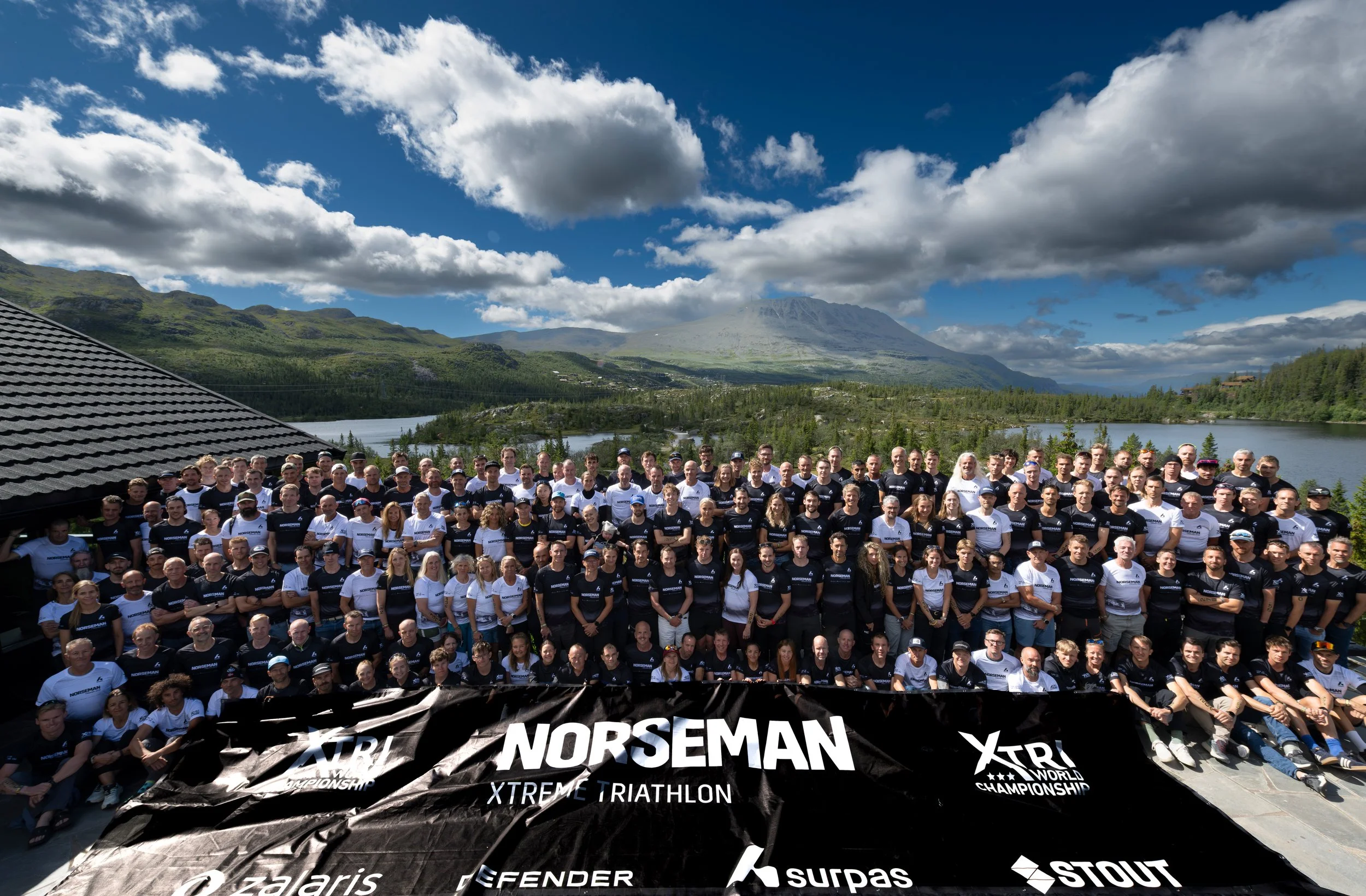
How do you prepare for something like the Norseman? The objective view is to train for the distance. Easy enough relatively speaking as it's an Ironman - 3.8, 180, 42.2. Then you go ‘okay it also has a lot of elevation on the bike (3000m+) and the run with 1800m vert and potentially very cold fjord.’
So you convert 'that' in training - hillier runs, long distance and more hills on the bike and long distance on the swim.
Then you prepare for the controllables: if the swim is cold get hoodie, booties and gloves.
You have to get there. Easiest route should be Sydney - Oslo or Bergen. But it’s expensive. And you want to stay and adjust to time zones. So fly into Denmark. Then rent a car, drive to the North of Denmark making the door to door trip some 34h. Three days later ride the car via the ferry overnight without sleep into Norway. Then drive over two days to Eidfjord.
But that's about where standard preparation ends.
Eidfjord water can be seriously cold. There is no backing out. It's irrelevant whether you like it or not - no matter what you will do, it will not be comfortable. You suffer more before and during, if you let it get to you. Expect to be cold and have hot drinks in transition. Towel off and wear layers to shiver back to warmth. Cold blood from extremities will make you colder for another 25 minutes 'after' exiting the water.
The ride is Alps like: five passes with reasonable gradients but long. 20km climb out of Måbødalen to Dyranut. Across Hardangervidda which can be hot, cold, headwind or tailwind, rain, sleet. By all accounts, it should be rideable. But the TT bike which makes sense on the flats is not great for climbing.
Then, the run. In theory go 0-25km and walk Zombie Hill 25-32km. Very few can run this thing. Then run 32-37km and walk/hike up to Mt Gaustatoppen.
Nutrition and hydration as usual: 90g/h carbs, 500-700ml hydration (60-70g/h carbs on the run).
Then race day comes closer.
Water temperature at Eidfjord on the days prior by swim test: cold water shock territory - you gasp whether you want to or not.
Weather forecast 3-5 degrees on Hardangervidda and passes. Cold descends. Run in the valley 20 degrees. Mt Gaustatoppen -2 degrees.
I had to adjust the layering system. Leg warmers, bought a long running pant to be able to pull it over the long leg warmers.
Brought my long sleeve wind breaker jersey for the bike but bought a meshed undershirt to allow water from the tri-suit to dry off and in case of overheating transport sweat away. Additional gilet to keep even more wind away or function as rain block.
Then it’s race day. 1:30am get up, after a good 5h of sleep, good carb load, coffee. Ferry leaves at 4am sharp.
I had bought a down jacket and brought a woolen hat to keep core temp up as long as possible. 2 minutes to rain shower with the fjord water: step in, get wet, get a feel for the cold. Everyone line up and get ready to jump. Distance to start line 400-500m. Then the horn goes. By feel I got into a rhythm. Temperature was cold and you could tell the body was getting incrementally colder. I kept quite warm but we also swam into a current. Coming around the turn buoy a cold water patch hit you extreme with ice cream headache and instant burn all over. Then the swim was done: 1:21 or 1:24... kind of irrelevant.
You get into T2 with your support. They help you get the wetsuit off and layers on. I decided to go with tri-suit, mesh, long sleeve and long leg warmers and gloves right off the bat.
Climbing the long way out of Måbødalen, I regulated temperature with taking my visor off, opening my long sleeve and taking off my gloves. Nutrition right away and timer set for 15 minute intervals. Nutrition was planned around 300g of carbs in a bottle, 30g chews in the top tube which would last me 5h. Hydration 2x 750ml bottles lasting anywhere between 2 and 3 hours (750ml/h or 500ml/h). It's cold so you don't really want to drink but have to or you pay for it.
Support was scheduled for kilometre 35, two hours after start, for exchange of hydration and then check-ins in case I need any clothing, then again at kilometre 125 for more nutrition and hydration.
Well laid plan until there is a traffic jam out of Eidfjord and you are faster than your support. No one there at kilometre 35. Quick hydration check: you can stretch to 3h. Ride on, they will catch up with the tracker. Ride across Hardangervidda - last gear is jumping; rear derailleur must have bent. Put mentally aside, ride 12 cog to 100 rpm, same same.
Flat, false flat, downhill hitting the 3h mark now at Haugastøl, same, 66km in, still no support car. Quick decision at a support-preferred car park: stop, ask another supporter to call my support. My support is stuck way behind and can't get to me because I am too fast.
I know I have a solid incline past Geilo, the 90km mark. That would make hydration ~400ml per hour. It's cold so I gamble but make a mental mark to ask other supporters should I start feeling thirsty. Technically not allowed but between a medical later and rule bending: who gives?
Past Geilo, on the hill probably kilometre 100, support car comes by. I grab food for 125km and hydration. From here on out it is easier as they will be closer and leap frog more or less.
The passes are controlled. I ride by wattage: 210-230W in my 34 (changed prior to competition) and 80rpm+ if possible. I don’t compete with anyone; it is a long day and it’s over when it’s over not on a hero hill. Also sit up and have hands on my elbow rests to keep hip flexors open. The bike route is serious uphills and serious downhills but I am not bombing them - unfamiliar roads and surface make for easy crashes.
Nutrition and hydration like clockwork. Three more passes onto Imingfjell which was nearly a mental breaker: not only did the gradient hike up (7-9%) and stayed continuously there, which meant even in the 34, power output was 250W+, and coming to the top I expected a downhill but it was a plateau with strong cross- and cross-headwinds. Head down, stay aero, take a sit-up rest if needed and get it done... plus a bit of drizzle for good measure. The wind up the fjells bites, so you're often cycling between warm, open jersey and cold which is physically taxing in such short repetition.
Then back downhill into T2.
Get out of all layers, tri-suit only, gut a bit on edge so easy on the gels now. Calculated for 60-70g/h but at that point 40g was a challenge. Had other carb sources as well (waffle type) but didn't taste any better. Pace out of T2 was actually 4:50 and then deteriorating to 5:30 but frankly the idea was to run not shuffle to the bottom of Zombie Hill. Mentally, that made it a lazy Sunday run in the 2h vicinity.
I asked support to check in every 2-3km as I didn't want to carry water/hydration - tried a flask to run with on the first two kilometres but that annoyed me. I was well struggling at the 20-25km distance but kept going.
I often heard beforehand that one makes a turn and sees Gaustatoppen in the distance and it is so far away. I cannot confirm that to be true.
For one, I am a mountaineer and things seem farther than they are so when I saw the mountain, to my eyes, it was reasonably close.
For two, I knew Zombie Hill was from 25-32km so that was my marker for uphill and nearly there so visual cues didn't throw me off one bit. 5km to the bottom is 5km
Zombie Hill was planned as mental reset so I walked it. I had no idea where I was seeded but positions didn't change much.
In fact, Zombie Hill was one of the first times I saw more than 4 people in succession. Except for the beginning I rode either solo, wondering whether I was off-course, or with two other cyclists to cap a pass.
I intended to eat and hydrate walking uphill which I did but the system was also getting a bit challenged so I took it easy. The switchbacks also didn't bother me: one foot in front of the other like on any other mountain until you are at the top. I had set ~2h for the 25km and about 1h for the 640m gain. Both of these came in close at 2:15h and 1h+.
Between the beginning of Zombie Hill at 20 degrees and a tri-suit, three quarters up when I could start feeling the mountain breeze, I had asked support for my run vest and rain run jacket to keep my core warm. From kilometre 32 onwards I exchanged hat for beanie and took it off when too hot and put it on when getting cold.
Now I had thought that I would hike to kilometre 32 and run again to kilometre 37 for the turn off up the mountain for the black shirt or the turn around for the white shirt; but the incline kept coming at too strong a gradient for me to be able to run it on fatigued (read: fucked) legs. My support now told me I was around 87th so well within black shirt territory so I decided to power walk and watch what my competitors would do: no one ran. And the few that did and passed me shuffled without putting much distance in so I let them go. I tried to run on some flatter parts but by now flexors and abs had adjusted to walking and were screaming at me so I resorted to keeping on walking but forced a shuffle run for the last 600m to wipe out any doubt I could have given more - I could not have.
Reached the check point, cleared for black shirt.
Starting the hike I knew the temperature to be -2 degrees at the top and safety required us to bring a fleece, gloves, waterproof jacket, rain proof pants and a beanie, emergency bivvy, lights, gels. Obviously getting more depleted meant core temp dropped at the same time as temperatures dropped but food was done (couldn't take any more of it) so I started putting more layers on: fleece first.
The mountain trail is rough; literal pile of rubble. First kilometre a reasonable dirt and block path, then it turns into moraine rubble. No clear foot placements anymore and you have to choose the most efficient path for footing and energy expenditure. I would dislike this type of terrain in mountain boots let alone in normal trainers as I could not have spare weight to change for my trail shoes.
5km to the top is 1km relatively easy and 4km harsh trail in worsening weather, increasing cold (lost feelings in my gloves), putting on long run pants pre-emptively (and good choice at that), rain jacket and flip up all hoodies over the head.
The last 3km go on for a long time, but again, the rule in the mountains is just to keep going. 1km out from the finish it started hailing/sleeting and wind made it seriously uncomfortable and frosty. We are talking wind that knocks you off-balance, not a bit of breeze.
And then you're up. At the station and the time tracker you see in the videos. Conditions were miserable and cold (fog, strong winds, sub zero temps) so I just wanted to turn straight around and head to the funicular to get out of the weather in the depleted state. Total time 14:43 I think but no one cares for time. Black shirt or no black shirt.
It was somewhat anticlimactic because one sees people being emotional and I wasn't at all. But I had a reflection on why that is.
I prepared in Australia through a few challenges to make it to the start line.
I can look back over ten years of continuous training. Through terrible conditions. I trained, raced and lived in any and every condition.
I worked physical labour that requires grit.
I love mountains. Layering systems, gear and temperature ranges are second nature. I know what I need and what I can get away with.
I calculated nutrition and hydration and prepped bags for my support that clearly stated what leg, what distance.
I packed the 'eventuality clothing' in case things turned out for the worse.
I prepped the bike, tested gearing, learned from mistakes. I rolled with unforeseen circumstances. I was limited in what I could bring due to airline weight restrictions but found a way to make layering work.
It is a lot of experiential knowledge and a dash of favourable conditions.
I wanted a test of 'the hardest thing'. Before the race I didn't know. It should be possible, but is it?
So when I got to the top I wasn't emotional because it wasn't unexpected or life altering. I rose to the challenge by being meticulous, adaptive and because I was familiar with the conditions on the bike, the run and on the mountains.
The motto says 'you are not ready' and 'this isn't for you' but it also says 'but maybe we were wrong about you'.
Yes it was for me. Yes I was ready. And yes it was hard. And that's what I came for, to see whether it would best me. The 2026 version did not.