
Top 5 Bike Skills for Time Trialling
In the first part of the cycling performance series I spoke about developing your skills as a cyclist to help improves your times.
Today we talk about what I call the “Big 5” - Power, Aero, Cornering, Cadence and Climbing
Unfortunately, the rise of the smart trainer has brought with it a reduction in the athlete’s skills needed to get faster on race day. Most athletes disregard the need for skill development in what is basically a simple discipline of time trialling.
Nothing could be further from the truth.
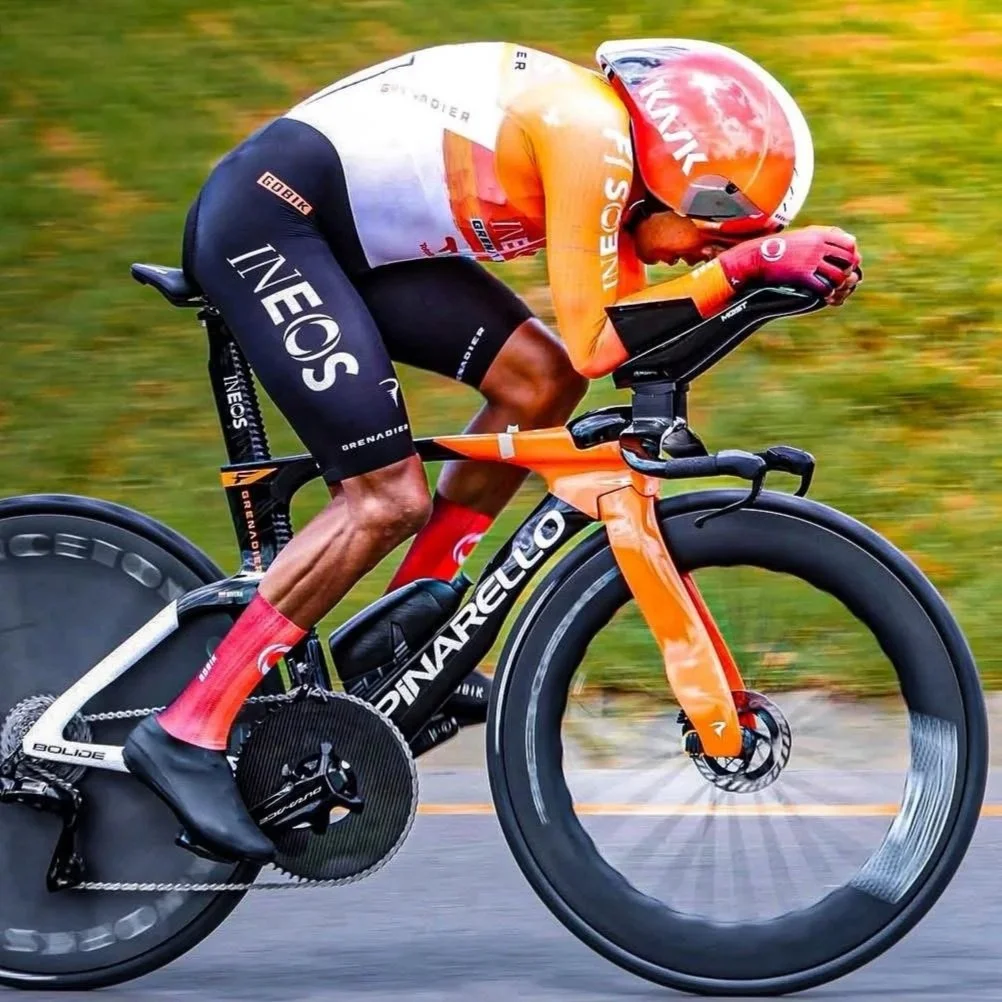
Time Trialling requires a number of skills. Holding even power, getting into a good aero postion and holding it there, maintaining speed through corners, pacing, driving strong power over climbs, and finally having a good cadence range are our “big 5” skills to develop
Power Application
Some athletes have a tendency to drift off when it comes to power application and have issues working through packs on the race course. This is a hard one to practice without having a lot of riders around you but you can simulate this in training with a bit of imagination. It’s all about being smooth and reducing variability and power spikes.
In Training - Choose an interval length of around 15min, get in your aero position and hold your target power. You are now in race simulation mode, imagine you are coming up on a group, back off a bit and then make a mental note of going around the group. Give yourself 1min above target race power to go around them and then back off to target power again. Don’t leave your aero-bars, maintain the correct cadence, don’t bomb through. Do 3-4 of these passes in your 15min race sim interval.
Holding Aero
Perhaps your biggest gains to be had are in this one skill alone. If you find yourself sitting up for various reasons then you are costing yourself time. A LOT of time.
The most common reasons? Muscular fatigue through the arms and neck, sitting up to eat and drink, sitting up as you approach a group and sitting up to corner.
In Training - Spend as long as you can down on the bars in your trainer sessions.
In your endurance rides on the road remind yourself to stay down on the climbs and descents, practice eating. and drinking in the bars and stay down to corner.
The major skill in holding aero is remembering to do it. It’s a mental skill.
Cornering
It can be suprising how many corners you go through in a race and the target here isn’t necessarily going super fast, but actually just minimising how much you slow down. You don’t want to have to push hard out of the corners and spike your power. That burns matches.
In Training - Choose a loop of 1-2km where you have minimal traffic and plenty of corners. Coming into the corner don’t grab a handful of brake. Feather the brakes and lean into the corner. Inside foot up, inside shoulder leaning into the corner. Eyes firmly focussed on the corner exit point. Go through the corner smoothly and start pedalling as you are leaving the corner. Stay in the saddle as you ease the power back on.
Climbing
Most athletes arent aware of how to use power over the various climbs on the day. The golden rule ? Know your course !
Check how long in duration your climbs are. If it’s a 1min climb then know what your best 1min power is and don’t go anywhere near it. You DO NOT want to burn matches. You want to let the power drift above race target a bit whilst watching your HR. Its okay to spend a bit of time at higher HR’s but dont let it drift too high or for too long.
In Training - Choose a hilly to undulating course and practice climbing without spiking power too much and holding your heart rate in control.
On low gradients stay seated, push back in the seat a bit, engage your larger glute muscles and drive through the pedal stroke.
On the short sharp steep hills practice getting out of the saddle to gain momentum and then get back in the saddle, shift foward a little and hold a higher cadence. Allow the higher power needed, come from higher cadence, not higher force.
Cadence Range
This is quite a personal one and something you have to undertand about yourself. The golden rule ? Have a cadence range not one target. Be good at cadences over 100. Be good at cadences under 70. But most importantly be great at cadences in the 80-90 slot. That is the sweet spot where you aren't driving your heart rate too high from spinning too much at 100 , and where you arent fatiguing your legs from the high forces required at 60. When I raced, I didn’t have power so I raced to cadence. I chose 85 as my number and the terrain and wind conditions would drive my gearing and as such dictated my speed.
In Training - do short pieces of 20-40sec at 100-120 cadence. Choose a gear thats “easy” and practice spinning your legs in circles. Try to make sure you don’t feel a specific push down or pull up. This improves your co-ordination and even application of power.
Then the opposite - do some 1-2min pieces in a harder gear and sit on 60. Push back in the seat a bit and drive with the glutes. Again, pedal in circles. Apply power evenly and engage the full range of muscles. Use the quads and the glutes as well as the hamstrings on the pull up phase. Notice them engaging but don’t overdo any one muscle group,
Lastly get on an undulating course and try to hold 80-90 evenly by changing gears as the terrain dictates. The major thing to remember in cadence is you are trying to protect your run legs so don’t overdo the lower cadences and as such the higher torques needed for that .
Conclusion :
There’s your Big 5 skill development components for time trialling. Each component should be trained. If you invest time and effort to do that you will be rewarded with faster bike times and improved run times as a result of the increased efficiency.